AVIATION
FEBRUARY 19, 2021
It’s a bird , it’s a comet… No, it’s the Blue Angels !
The start of US Navy Blue Angels aerobatic team was initiated by Chief of Naval Operations Adm. Chester W. Nimitz at the end of World war II. In order to raise the public’s interest in naval aviation and boost Navy morale, he ordered the formation of a flight demonstration team.
In April 1946, the Blue Angels were originally formed as the Navy Flight Exhibition Team. According to the Blue Angels official website the name changed to Blue Angels after Right Wing Pilot Lt. Maurice “Wick” Wickendoll came across the name in the New Yorker Magazine in a column called Goings On About Town for a nightclub called the “Blue Angel”. While the US Naval Institute website states that previous name suggested for the team had been the Blue Lancers.
The team was introduced to public as the “Blue Angels” at a show in Omaha, Nebraska, in July 1946. This Flight Exhibition team was the second formal flying demonstration team in the world, since the Patrouille de France formed in 1931. Since 1946, the Blue Angels have performed in front of nearly 500 million spectators worldwide, travels to airshows around the world to exhibit aerial maneuvers.
Usually the Blue Angels show season runs every year from March until November. They run the show at various places from military to civilian airfields and often perform directly over big cities such as New York, San Francisco and Los Angeles too.
A tragic accident occurred on April 21, 2007 when Blue Angels number 6 crashed during the final minutes of an air show at the Marine Corps Air Station Beaufort in Beaufort, South Carolina. Pilot Lieutenant Commander Kevin “Kojak” Davis died and eight nearby residents were injured. Some property near the crash site were damaged by the flying debris from the exploded plane. US Navy released an investigation report in early 2008 states that Lieutenant Commander Davis lost control of the aircraft due to G-force-induced Loss Of Consciousness (G-LOC).
On June 2, 2016, another Blue Angels jet crashed during a practice run in Tennessee, killing the pilot Marine Captain Jeff Kuss. No civilians were injured during the crash. The team was preparing for a weekend air show in Tennessee when the airplane hit the ground around Smyrna, a town to the southeast of Nashville.
The team is stationed at Forrest Sherman Field, Naval Air Station Pensacola, Florida, during the air show season. From January through March The squadron doing training at Naval Air Facility El Centro, California. Their practice sessions can be viewed by public on land or by sea. Several local boating companies offer tours on a regular basis to watch the jets in actions.
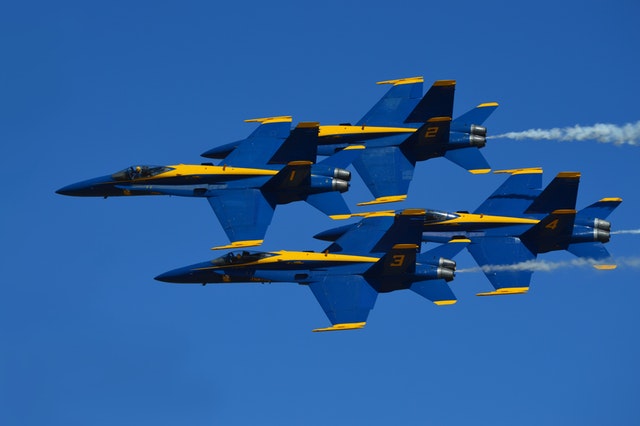
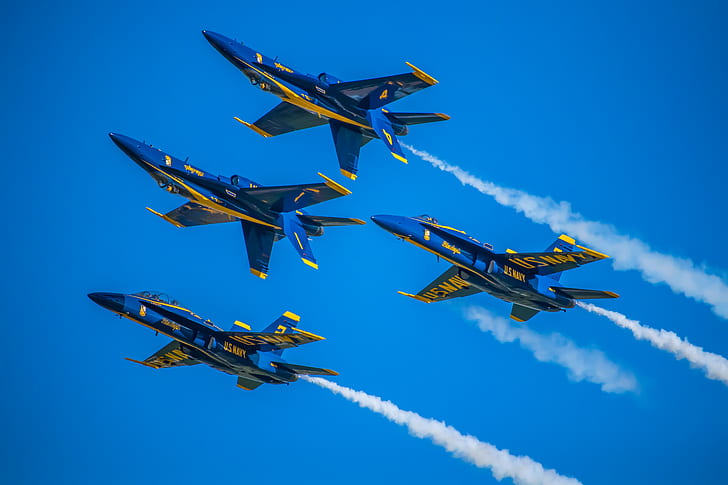
The Blue Angels have been using F/A – 18 Hornet as their demonstration plane since 1986. They fly the jet in more than 70 shows at 34 locations all over the United States each year. Many of the maneuvers and techniques from 1946 still being used in their aerial display. In 2010 they had transition to the latest Hornet variant C and D since discontinued. The planes used for aerial shows have unique modifications such as special paint, smoke generators to produce smoke tail during the show and fuel pumps operable as the aircraft fly upside-down.
On November 4, 2020 the Blue Angels conducted a final flight using six “Legacy” F/A-18 Hornets. This final flight of the Legacy Hornets marks the official transition of the team to the new F/A-18 E/F Super Hornet platform. The Super Hornet first deployed into combat operations aboard the USS Abraham Lincoln (CVN 72) is July 2002 and remains the main fighter and attack jet of the U.S. Navy carrier-based fleet today.
The Blue Angels have flown F/A-18s (A,B,C,D) known as “Legacy” Hornets for almost 34 years, making it the longest-serving Blue Angels platform. The US Navy retired its last Hornet from operational service in 2019 but the US Marine Corps still operates the Hornet for their combat missions today. The Super Hornet variant will become the third Blue Angels aircraft operating with General Electric (GE) engine. Before this the GE engine was used to power up F-4j Phantom II from 1969 to 1974 and the F/A-18s Legacy Hornets.
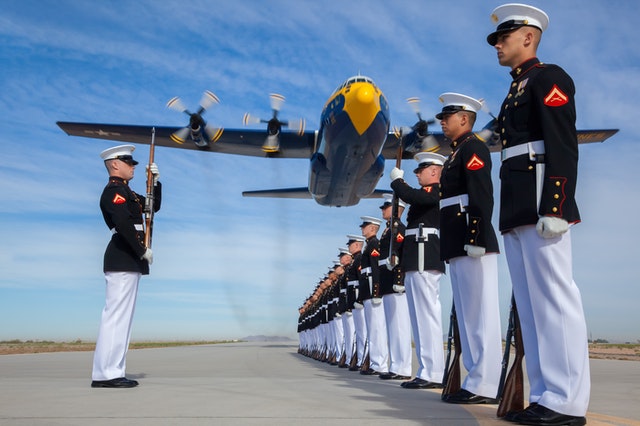
In addition to move personnel and equipment between show sites it is necessary for the Blue Angels to operate a support aircraft. In 1949 they began to operate a support aircraft, from Douglas R4D Sky Train, the Curtiss R5C Commando, the Douglas R5D Skymaster, and the Lockheed C-121 Super Constellation. In 1970 the Blue Angels received the Lockheed Martin C-130 which is still operating until today by the nickname “Fat Albert”.
List of aircraft used by Blue Angles from past to present
For more information about US Navy Blue Angels and the schedule of their shows you can visit the Blue Angels website here.
Related post