AQUATIC SPORTS
SEPTEMBER 12, 2021
Brief Summary Of Swimming
A brief summary of swimming could be started to know first that swimming is one of the oldest sport in the world. Earliest records of recreational swimming date back to Stone Age paintings from around 7.000 years ago. In Egypt and Greek including Roman, swimming have been practiced about 2500 BC according to archaeological evidence in form of Egyptian drawings.
Some stone age paintings in the Cave of Swimmers have dates back even further. The paintings shows prehistoric man learned to swim in order to cross rivers and lakes, or maybe to defend themselves from hostile creatures. Other condition where man had to swim might took place because of basic needs such as driven by hunger to search for sea food.
It was a part of martial training and was a part of basic survival skill for males in the ancient Greece and Rome civilizations. The skill was adopted as a military technique from its early days for the warriors and troopers as a part of martial training and wars.
Swimming found its form as a competitive sport in the 1800’s in England. The first indoor swimming pool was opened to the public in 1828 by the name St. George’s Baths. Since then national swimming championships were organised since the middle of the 19th century in England.
By 1837, the National Swimming Society was holding regular competitions around London and in 1880 the Amateur Swimming Association, the first national governing body was formed with over 300 clubs across the country. Swimming was first introduced at the Olympics in 1896.
The international governing body for competitive swimming is the Fédération Internationale de Natation (“International Swimming Federation”) or better known as FINA, founded on July 19, 1908 with headquarters in Lausanne, Switzerland. It is the official international federation recognised by the International Olympic Committee (IOC) for administering international competitions in water sports.
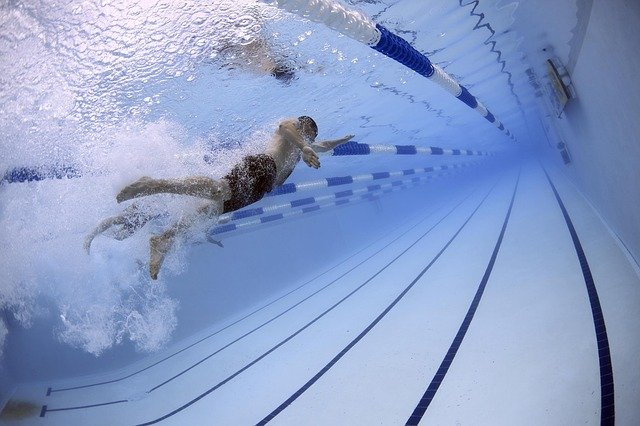
Just like any other sport branch, some innovations in swimming help people to make better swimming performance such as Benjamin Franklin who invented swim fins to help swimmers move through the water more efficiently and easier.
With regular swimming schedules our body would stay fit and healthy. It builds endurance, muscle strength and cardiovascular fitness along with strong heart and lungs. As you move through the water your heart and lungs work harder to send oxygen to muscles. This will increase your lung capacity and stamina in the long run. The more you swim, the more your body will change. Creating broad-shouldered, thin and fit body shape.
But swimming takes time to learn. Some people can float naturally in the water than the others. Some people cannot because they are too nervous in the water. Muscular people might have difficulties floating and for people with low body fat percentage, floating in the water could be a problem either.
To make it easier to float try to float on your back. This way your body could float naturally as long as the water your body displaces weighs more than you do, then you will float. Your lungs are full of air like a balloon and the air lifts you to the surface of the water, floating naturally. Just like the Archimedes’ Laws.
related post