
MARINE NAVIGATION
JUNE 13, 2021
Evolution Of Lighthouse Technology
The evolution of lighthouse technology has developed so much compared to the early years especially after the invention of electricity.
Lighthouses and beacons are towers with bright lights and fog horns located at important or dangerous locations. They warn mariners of dangerous shallows and rocky coasts. They also guide vessels safely into and out of harbors.
Usually they can be found on dangerous locations for ships, such as rocky cliffs or sandy shoals on land, on wave-swept reefs in the sea, and at the entrances to harbors and bays.
During ancient time, mariners were guided by fires built on hilltops. It would improve the visibility at night and this led to the development of the lighthouse. Unlike many modern lighthouses, ancient lighthouses functioned more as an entrance marker to ports than as a warning signal.
The most famous lighthouse from ancient era was the Pharos of Alexandria, Egypt which unfortunately collapsed during a series of earthquakes between 956 CE and 1323 CE. The Tower of Hercules at A Coruna, Spain still exist and gives information about ancient construction of a lighthouse. It is considered as the oldest existing lighthouse in the world that dates from 20 BC.
In the 18th century when transatlantic commerce increased significantly many lighthouses were built and the modern era of lighthouses began. The first tower in the world to have been fully exposed to the open sea was built by Henry Winstanley from 1696 to 1698.
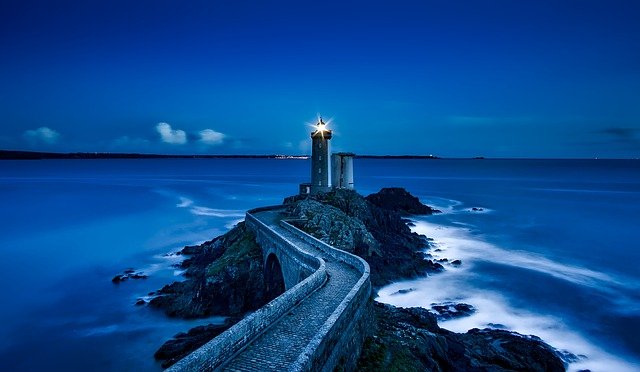
The first lighthouse in America was at Boston on Little Brewster Island (1716). The first keeper was George Worthylake who was drowned along with family, when returning to the island in 1718. The original tower was destroyed by the British and eventually reconstructed in 1784.
Later on from 1756 – 1759 a civil engineer, John Smeaton, rebuilt the lighthouse. He developed a technique of securing granite blocks and a form of concrete. His light house was the prototype for the modern lighthouse.
In 1782, Swiss scientist Aime Argand invented the Argand lamp that revolutionized lighthouse illumination and became the standard for lighthouses for over a century.
Electric light was successfully used in 1875 by South Foreland Lighthouse. John Richardson was the first to develop a system for gas illumniation. Followed by the use of Dalen light, invented by Gustaf Dalen from 1900’s to the 1960’s.
French physicist and engineer Augustin-Jean Fresnel developed the multi-part Fresnel lens for use in lighthouses. The first use of Fresnel lens was used in the Cordouan lighthouse in 1823. The light was visible for more than 20 miles (32 km).
Today, the most powerful optic produces from a lighthouse can be seen 25 miles at sea, although aircraft have reported “picking up” a light at 40 or 50 miles due to the reflections of clouds.
related post