MARINE VEHICLE
MAR 13, 2022
History And The Development Of Hovercraft
Get to know about history and the development of hovercraft, a unique vehicle that able to roam across water and land.
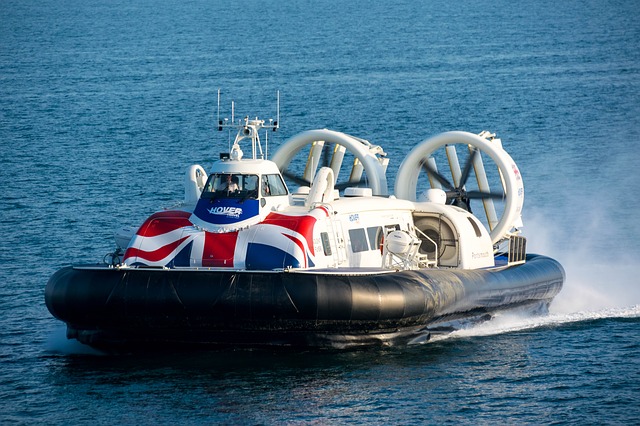
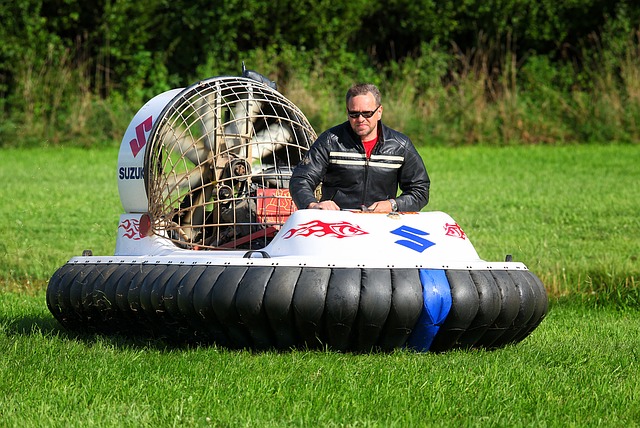
A hovercraft is a vehicle that runs on an air cushion. The air cushion is raised by blowing air into the lower space of the hovercraft (plenum chamber) through a skirt (flexible block) so that the air pressure inside the plenum chamber is higher than the outside air pressure so that a lifting force arises. To move the hovercraft, the propulsion force obtained from the propeller is used as in an aircraft.
The way the hovercraft works is that the engine rotates the propeller (fan) through a gearbox or belt drive. The airflow generated by the propeller will push the hovercraft forward. In order for the hovercraft to float, a third of the propeller flow is channeled through the transfer duct. Air from the transfer duct will fill and expand the air cushion (skirt) that is installed around the body. The bottom of the air cushion is perforated so that air can flow down and lift the hovercraft. In order to be able to turn, behind the propeller is installed a rudder that will direct the airflow to the left or right.
The first recorded design of a hovercraft-like vehicle was in 1716 by Emanuel Swedenborg, a Swedish designer, philosopher and theologian. The design is a human-powered air cushioned vehicle with a cockpit in the middle. But since human power is not strong enough to carry out the mechanization it uses, that concept vehicle is not built.
Christopher Cockerell was the first to use the name Hovercraft to refer to a vehicle that uses the airbed principle. In 1952, this British inventor succeeded in designing a vehicle according to the working principles of Hovercraft. This discovery is considered the most successful finding compared to similar efforts that have been made by several predecessors in this field. Then in 1959, Cockerell succeeded in realizing this design and since then the name Hovercraft was used to refer to this air-cushioned vehicle.
However, at that time hovercraft still did not wear skirts like the ones used today. This part (skirt) was first introduced by a member of the British Royal Navy, Latimer-Needham. This section is used to support a new system in hovercraft called the Flexible Skirt System. The skirt is made of strong rubber and is attached to the side of the entire hovercraft hull so that it looks like a skirt at a glance.
After undergoing many technical improvements, hovercraft began to be manufactured in a factory. In the following years, the basic working principles of this vehicle were used by the Saunders Roe, company that manufacture many hovercrafts.
The company was funded by Britain’s National Research Development Corporation and the first hovercraft produced was the SR type. The N4 type has a capacity of 254 passengers and 30 vehicles.
According to Wikipedia, hovercraft itself has several types:
1.Open Plenum
This type uses an open space construction with a large chamber filled with high pressure air. This kind of construction requires a large amount of energy to ensure a high enough pressure.
2.Peripheral Jet
Construction designed by Sir Christopher Cockerel using an annular jet (ring), air is pumped around the sides of the vehicle. Less power is required, to generate the air cushion bed continuously.
3.Flexible Skirt
In this construction, the flexible shroud of the annular jet causes an increase in the altitude of the hovercraft’s position up to 10 times, so that the hovercraft can traverse uneven ground and unfavorable coastal terrain.
4.Fixed Wall
In this construction, this hovercraft with standard sidewalls is known as CAB (Capture Air Bubble), equipped with a compact casing on the bow side while the sidewalls can tightly cover the air cushion on the underside of the vehicle.
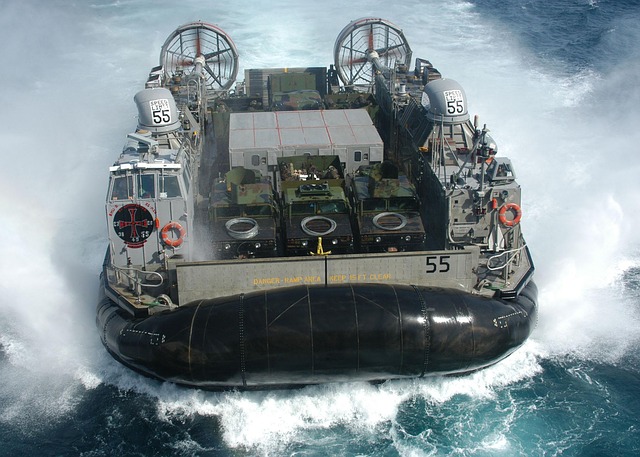
Currently, most Hovercraft are operated by the British state. This is natural because the largest Hovercraft factory, the British Hovercraft Corporation, is located in this country as well. The UK operates a lot of Hovercraft for Ferry crossings. But until now, if you look at the percentage, the military uses the services of this vehicle more than the civilian world.
Hovercraft has the potential to be operated in Indonesia, considering that this country consists of thousands of islands, hovercraft can be used as a link between islands or used as a tourism vehicle. The use of hovercraft is proven to be effective in reducing operating costs by up to 35% than aircraft.
related post