
ASTRONOMY
AUGUST 30, 2021
The Red Supergiant Star Betelgeuse

Betelgeuse is the second brightest star in the Orion constellation after Rigel.
Its Bayer designation is a Orionis or Alpha Orionis in Latin with Alpha Ori for the abbreviation. Distant from Earth is approximately 724 light years away but is easily discovered with naked eyes in the night sky due to its brightness and deep reddish color.
The spectral type of Betelgeuse is a red supergiant M1-2 type star, roughly 950 times larger than the Sun and one of the largest stars visible to the naked eye. Several larger stars in the Milky Way including supergiants like Mu Cephei and hypergiant VY Canis Majoris. A red supergiant is a type of star that is more massive than the Sun but thousands of times shorter-lived.
This red giant is expected to end its life in 100 thousand years with a supernova explosion. In 1920, Betelgeuse became the first extrasolar star whose photosphere’s angular size was measured.
Britannica website explains that the name Betelgeuse is derived from the Arabic word bat al-jawza meaning “then giant’s shoulder”. The magnitude of the star is about 0.6 but in late 2019 it began to dim to magnitude of 1.6 by early 2020 then returned to its original brightness that year.
This led to a speculation that the red supergiant was about to explode and becoming a spectacular supernova. The last time a supernova in the Milky Way that could be observed from Earth was in 1604.
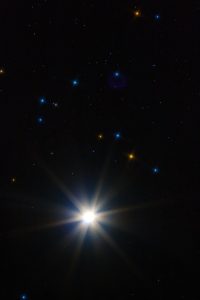
In an article on the nature website, scientists considered this event was caused by a giant ejection of gas that condensed into dust when it cooled or a cloud of dust crossing the line of sight of the star. This enabled gas that the star had spewed out in the previous year to condense quickly into dust, blocking out light from the star.
The team took a series of high-resolution images of the star in January 2019, December 2019, January 2020 and March 2020, using the Very Large Telescope in Chile’s Atacama Desert. The team’s explanation for the dimming is that an unusually cool convective cell led to a drastic drop in temperature in the star’s atmosphere.
This scenario was the best prediction as it fit the data best and confirmed by more than 10.000 computer simulations run by the team. Astrophysicist Miguel Montargès at the Paris Observatory says “The conclusion from the modelling is that both events happened at the same time.”
As for the supernova explosion, researchers still don’t have enough understanding of Betelgeuse and other red supergiants in general. Further data and research with technology advancement should be conducted to be able to make a prediction : how many days or years red supergiants stars are about to explode as a supernova.
Betelgeuse has been the object of observations since thousand years ago. Chinese astronomers describe Betelgeuse as a yellow star. Three centuries later Ptolemy, the classical astronomer described its color as rubedo or “ruddiness”. The Aborigins in Australia passed oral tales of the Betelgeuse’s changing brightness for at least one thousand years.
In 1836, astronomer Sir John Herschel published his observation of the star. The records of the American Association of Variable Star Observers (AAVSO) show a maximum brightness of Betelgeuse of 0.2 in 1933 and 1942, and a minimum of 1.2, observed in 1927 and 1941.
The 1950’s and 1960’s saw two developments in red supergiants research : the Stratoscope projects and the 1958 publication of Structure and Evolution of the Stars by Martin Schwarzschild and Richard Harm.
related post