DAILY TOOLS
JUNE 1, 2022
The Essential History And Origins Of Spoon

Spoon as one of the most important eating utensils has a long history and various origins since thousand years ago.
Eating is a mandatory activity for humans. Therefore, cutlery is also an object that is easy for us to find. One utensil that is often needed is a spoon. This object is a tool for taking and feeding food into the mouth.
A spoon is a cutlery that has an oval or oval-shaped concave at one end and a handle at the other. This spoon is the most basic of the main cutlery. In addition to bribing, this spoon also serves to cut side dishes, spread food, or move food.
Spoons are used primarily for eating liquid or semi-liquid foods, such as soups, stews or ice cream, and very small solids or flours that cannot be removed easily with a fork, such as rice, sugar, cereals, and peas.
In Southeast Asia, spoons are the main utensil used for eating; forks are used to push food such as rice onto spoons as well as their western use to stab food.
According to a 2013 Gizmodo report, the spoon is the oldest eating utensil in the world. Historically, spoons have been used since the Paleolithic era, or about 50,000 to 100,000 years ago. Initially, spoons were made using natural materials such as sea shells, or stones.
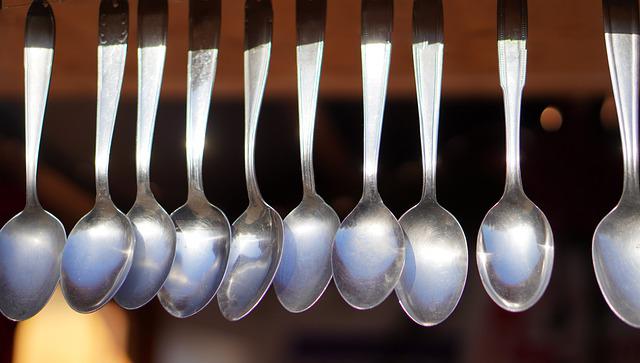
The earliest evidence of the use of this spoon was found by archaeologists. In addition, many ancient texts describe the use of spoons.
The remains of the first spoon we know of were found in the ruins of Ancient Egypt in 1000 BC. Back then spoons made of ivory or slate were used for ritual purposes. Since then, spoons have been used in almost every food culture in the world.
It is said that the first nation to pioneer and create spoons with designs that we know today was the Romans in the first century AD.
During the Ozieri Neolithic civilization of Sardinia, ceramic spoons were widely used. In the Shang Dynasty, China, spoons were made of bone. Early bronze spoons in China were designed with sharp edges, and were probably used as cutting tools as well.
The term “spoon” in English comes from the Greek “cochlea”. This term means snail, which means spoon in the Greek and Roman empires still using snail shells at first.
As civilization developed, spoons began to be made using bronze or silver materials. But those who use spoons made of bronze or silver are only the rich.
According to archaeologists, the modern spoon as we know it today was first made in England around the 12th century.
At that time, spoons were also used as a sign of wealth and power in England. For example for the coronation ceremony of the King of England or religious rituals.
When the industrial revolution emerged in England, people in the middle class experienced an increase in income. This was the time when people spend their money on spoons.
Seeing this trend, the industry began to introduce more diverse spoons. Starting from tablespoons, teaspoons, and serving spoons.
Bee Wilson, a food historian, wrote in his book “Consider the Fork: A History of How We Cook And Eat” that spoons are part of the technology that has changed the way we eat food.
In general, modern day spoons as cutlery or cooking utensils use several standard materials such as stainless steel, steel, or wood.
Spoons are made of stainless steel (metal alloy) because stainless steel is not easy to rust. This is due to the composition between the left and right metals in the voltaic series. As a result, it is not easy to rust, corrode, expand etc.
Easy to clean, stainless steel is an insulator so it is not easy to stick with other materials. Extremely strong, stainless steel spoon is made of metal that is so tightly packed that it doesn’t contain pores.
Today, the development of spoon has not stopped growing. Many experts invent new types of spoons. From edible spoons to electric spoons.
related post